

The Workshop Methodology and Resources

Getting Started
How to Use the Roadmap in This Workshop
In this Area, the draft roadmap is used as a conversation starter and co-design tool. Participants will:
- Review the roadmap visually and conceptually, using the image as a metaphor for the learning and action journey;
- Reflect in small groups or pairs on which elements feel most relevant or missing in their own local contexts;
- Be invited to place themselves on the roadmap — where do they currently stand? What is the “next step” they would like to take?
- Begin suggesting edits, additions, or adaptations to the roadmap based on lived experience.
Facilitators should make it clear that there are no “right” answers — participants can challenge the order, content, or structure of the roadmap. This is their opportunity to shape the shared tool they will use throughout the next Areas.
Key Messages to Reinforce
- The roadmap is a living tool — it evolves with your input.
- Your voice is central — this process is about co-creating pathways to systemic change.
- We start by setting the scene because transformation requires shared clarity and trust.
The roadmap tool for this step
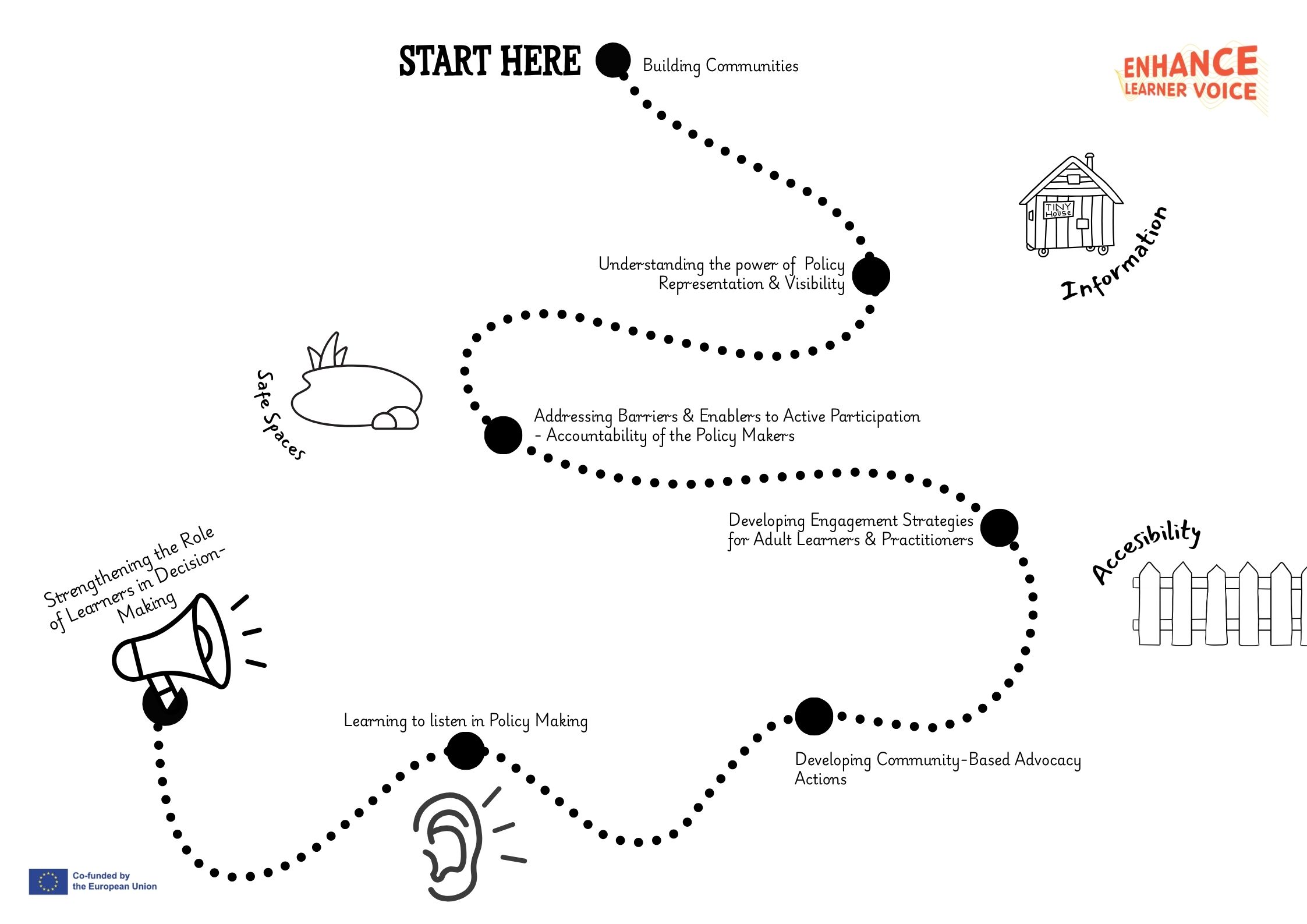
“The River of Voice”
Purpose: To help participants connect through personal experience and reflect on what voice and participation have meant in their lives.
How it works:
- Introduction (2 min): Invite participants to imagine their own “river of voice” — moments in life where they felt heard, silenced, empowered, or ignored. These can be from education, work, family, or civic life.
- Silent Reflection (5 min): Ask each person to sketch or map their “river” on a piece of paper (or digitally), marking a few key moments along the way. No artistic skills needed — just symbols or words.
- Pair Sharing (10 min): In pairs, participants take turns sharing their river and briefly describing one or two moments that stand out.
- Group Debrief (10–15 min): Come back together and reflect as a group:
- What did it feel like to reflect on your voice?
- What conditions helped you feel heard?
- What do we need to make this space one where all voices can flow?
Why it works:
This activity centers participants’ lived experience and gently shifts the conversation toward voice, participation, and trust. It helps break down hierarchies and encourages empathy.
“We Share / We Don’t Share”
Purpose: To quickly uncover common ground and respectfully acknowledge difference among participants.
How it works:
- Preparation: Prepare a list of 8–10 statements (see examples below). These should be broad, relatable, and designed to spark connection or insight.
- Instructions: Read out each statement one at a time. After each one, participants move to one side of the room (or use emoji/thumbs up in online chat) if it resonates, or stay seated if it does not. Invite people to look around and notice patterns.
- Optional: After each movement, you can ask a few people to explain their choice if they feel comfortable.
- Debrief: Reflect as a group:
- What surprised you?
What does this activity tell us about who we are — individually and together?
How can we honour both shared and different experiences?
Sample Statements:
- I consider myself a lifelong learner.
I’ve felt left out of decisions that affect me.
I speak more than one language.
I’ve struggled to access education at some point in my life.
I believe communities have the power to change systems.
I’ve seen policy work… and I’ve seen it fail.
Why it works:
This activity builds a shared emotional “map” of the group — reinforcing that while differences exist, there is also powerful common ground. It lowers barriers and fosters mutual respect without requiring deep vulnerability.
Building Shared Agreements
After initial activities, facilitators may choose to co-create a set of community agreements or “working principles” for the sessions. These could include:
- Listen to understand, not to reply.
- Speak from personal experience.
- Stay open to discomfort and learning.
- Respect language and cultural differences.
- Step up, step back (balance participation).
These agreements can be noted on a visible poster or digital slide, and revisited or revised throughout the workshops as needed.
Closing the Area: Holding the Community Lightly
This is a short community — built for the duration of this meeting or series of workshops — but that doesn’t make it less real. What is built here can echo far beyond the meeting room, in new practices, partnerships, and insights. This Area is not about creating permanent groups, but about setting the tone and shared ethic for what comes next.
“Mapping the Practices”
- Small Group Work (20–30 minutes)
Break into small groups (3–5 people). Each group receives a large sheet of paper (or shared digital board) with a simple grid or map. They are asked to write down or sketch:
- Examples of where learner voice exists in their setting
- Tools or strategies used (e.g. councils, peer support, policy feedback, storytelling)
- Who initiates the practice, and who benefits
- Whether these practices are formal, informal, or grassroots
- Gallery Walk or Group Sharing (10–15 minutes)
Groups place their maps around the room or present key examples. Participants move around and add comments, questions, or connections with sticky notes or in discussion.
“Case Study Deep Dive”
Invite one or two participants to present a practice in more depth — describing not just what it is, but how it was developed, what made it work, and what challenges remain.
Facilitation Tips
- Emphasize that practices can be small-scale and still significant.
- Avoid idealizing examples — encourage honest discussion about limitations and learning.
- Validate informal or cultural practices that may not be “recognized” but hold power.
Link to the Roadmap
This Area supports progress along several roadmap points,and the practices identified here may serve as case studies or evidence in later Areas — particularly when participants work on advocacy actions or policy design. Ask the participants to recommend where in the roadmap these practices that you are discussing fit in.
“From Experience to Recommendation”
Step 1 – Reflection (10–15 minutes)
Each participant reflects individually or in pairs:
- What did we hear in earlier Areas that revealed a gap in policy?
- What is one issue that feels urgent and possible to change?
Step 2 – Group Work (20–25 minutes)
Participants work in small groups to answer the following three questions:
- What should change in policy?
Be as specific as possible: funding rules, consultation processes, curriculum design, access criteria, language support, etc. - Who needs to hear this?
Identify the relevant policymaker(s): e.g. ministry officials, local authorities, education providers, EU actors, etc. - How did the roadmap help or hinder this expression?
Did the steps and visuals of the roadmap support clear thinking? Were any key issues or stages missing from it?
Step 3 – Share and Synthesize (10–15 minutes)
Each group presents 1–2 key recommendations and answers the three core questions. Facilitators record the results for use in reporting and toolkit development.
Tips for Facilitators
- Reassure participants: you don’t need to be a “policy expert” to see what needs to change.
- Support clarity and feasibility, but do not limit ambition — this is a space to practice power.
- Validate the knowledge participants bring from lived experience and professional practice.
- Ensure that learners are not overpowered by institutional voices during group work.
Link to the Roadmap
This Area supports progress along several roadmap points,and the recommendations identified here may serve as steps in the roadmap, re-routes or alternative paths. Ask the participants to recommend what the role of their recommendations would be.
“The Wall and the Bridge”
Step 1 – Story Circles (20 minutes)
In small groups (3–4 people), invite each participant to share a short story of a time when:
- A learner voice initiative faced strong resistance
- Their voice (or someone else’s) was not taken seriously
- A promising action hit a “dead-end” (policy, funding, internal power dynamics, etc.)
Encourage honest, non-performative storytelling. This is not about polished narratives — it’s about making the struggle visible.
Step 2 – Pattern Mapping (10–15 minutes)
On a large sheet or whiteboard, each group writes down the barriers they heard across stories (e.g., gatekeeping, lack of time, low confidence, political resistance, no feedback loops). Highlight recurring themes.
Step 3 – From Wall to Bridge (15–20 minutes)
Now shift the lens: what helped participants move forward — or what could help next time? Write these “bridges” beside the “walls.” They might include:
- Peer support
- Involving learners earlier in the process
- Partnering with CSOs or allies in the system
Changing language or reframing arguments
Systems Reflection
Facilitators can invite the group to place the identified “walls” and “bridges” onto the ENHANCE Roadmap itself. Where do these blocks typically appear in the process? Are some stages more vulnerable than others? This helps refine the roadmap for future use.
Facilitator Tips
- Normalize challenge and failure — they are part of real change.
- Frame “dead-ends” not as endings, but as places that require rethinking.
- Listen carefully to silences — sometimes what’s not said reveals structural pain points.
- Be aware of emotional load; ensure time for closure and support if heavy experiences arise.
How This Area Strengthens the Roadmap
This Area is a reality check. It enriches the roadmap by introducing feedback loops, allowing the process to acknowledge and integrate failure, resistance, or diversion. This makes the roadmap not only more realistic but more usable.
Collecting Data
The ENHANCE Workshop Data Sheet
This Area introduces and supports the use of the Workshop Data Sheet – Roadmap Testing for Inclusive Adult Learning Policy, a tool developed by the ENHANCE consortium to capture rich, multi-dimensional data across all workshop Areas.
This tool is to be completed by facilitators and co-facilitators — ideally in real-time or directly after the session. It is structured to:
- Align directly with the flow of the workshop Areas;
- Capture both quantitative and qualitative information;
- Support the aggregation of insights from multiple sites;
- Enable the project team to identify patterns, gaps, innovations, and tensions.
Framing the Tool in Use
Facilitators are encouraged to:
- Introduce the purpose of the data collection to participants at the start of the workshop series;
- Reassure participants that data will be anonymized and used for reflection, not judgment;
- Engage co-facilitators or note-takers where possible to avoid the burden of solo documentation;
- Use quotes, visuals, or emotional observations with participant consent, especially when photos or personal reflections are involved;
- Make the tool visible and open to feedback — treat it as a shared resource, not a hidden checklist.
Ethical Considerations
- Informed consent must be obtained when collecting identifiable data, photos, or direct quotes.
- Make space for withholding or withdrawing consent at any time.
- Ensure accessibility of the tool — it should not create barriers for facilitators with different communication or processing styles.
- If translating notes later, retain original meaning and nuance wherever possible.
Using the Data for Change
The information gathered through this Area will:
- Support the ongoing refinement of the ENHANCE Roadmap;
- Feed into national and EU-level policy recommendations;
- Contribute to toolkit development, podcasts, and case studies;
Recognize the contributions of adult learners and community educators in a documented, visible way.